
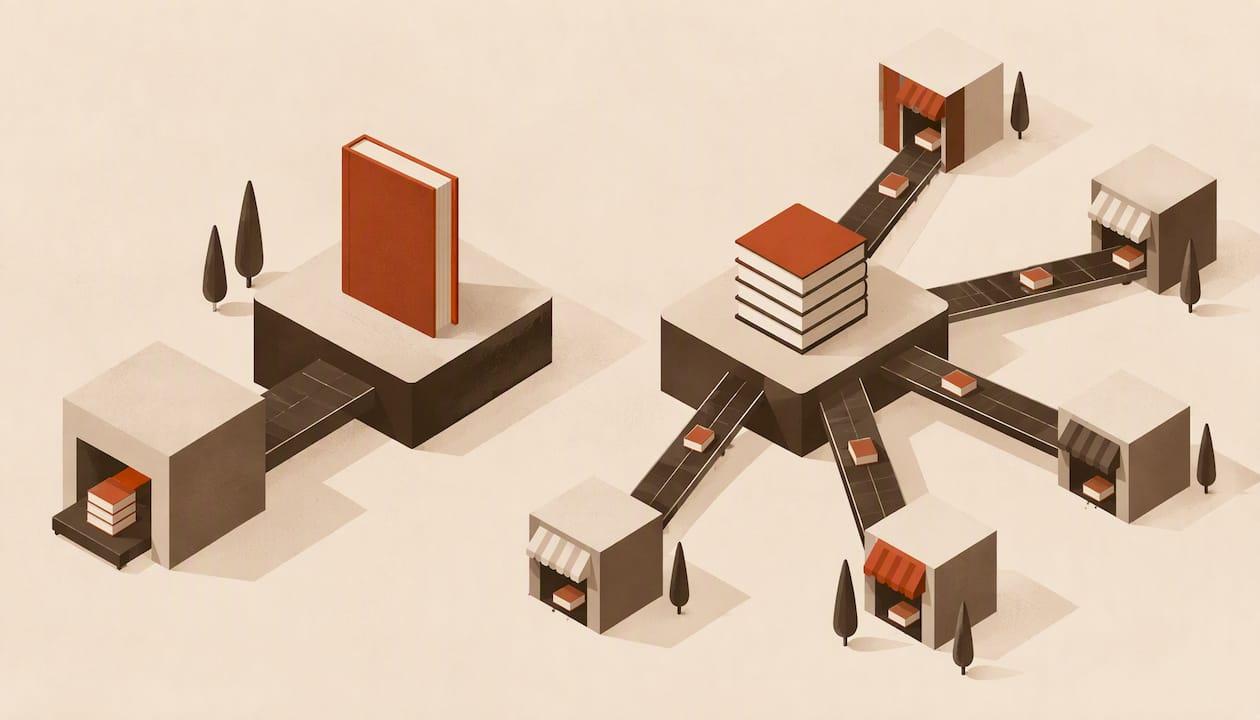
Use KDP if Amazon is where most of your readers will buy. Use IngramSpark if you want bookstores, libraries, and wholesalers to be able to order your book. Most authors who want both reach do both: KDP for Amazon, IngramSpark for everything else, with one ISBN you own. This guide compares the two on royalties, print options, ISBNs, distribution, and setup, then shows how to run them side by side without conflicts.
Key Takeaways
- KDP is a retailer. It lists your book on Amazon and pays up to 60% print royalties with no upfront inventory.
- IngramSpark is a wholesaler. It puts your book in catalogues used by bookstores, libraries, and academic buyers, and you set the wholesale discount.
- You can use both for the same title if you skip KDP Expanded Distribution and use your own ISBN on both.
- Both platforms reject files that fail their specs, so a validated print PDF saves more time than any platform choice.
- Check fees and rates on each provider's own page before you publish. Both change them.
Table of Contents
- KDP vs IngramSpark at a glance
- Royalties and costs
- Distribution: Amazon, bookstores, and libraries
- Print options and quality
- Setup, proofing, and approval
- ISBNs: the rule that trips people up
- Using both platforms without conflicts
- Which should you choose?
- Our perspective
- Format once, upload to both
- FAQ
- Sources
KDP vs IngramSpark at a glance
| Amazon KDP Print | IngramSpark | |
|---|---|---|
| Type | Direct-to-consumer retailer | Wholesaler and distributor |
| Main strength | Amazon listing, fast setup | Bookstore, library, and global reach |
| Print royalty | Up to 60% of list price, less print cost | You set list price and wholesale discount (40%–55%) |
| Hardcover | Case laminate only, no dust jacket | Dust jacket, digital clothbound, casebound |
| Returns | Not applicable | You choose: non-returnable, return/deliver, return/destroy |
| ISBN | Free KDP ISBN or your own | Your own ISBN |
| Review time | Typically faster | Typically slower |
The split comes down to how each service sells. KDP is Amazon's free self-publishing service for digital and print books, and you keep control of content, design, pricing, and advertising. IngramSpark offers tools to publish, print, promote, and sell print and ebook formats through a trade channel.
The practical summary from one publishing-advice site: KDP gets you listed on Amazon at the best royalty rate, while IngramSpark gets you into the catalogues bookstores and libraries use.
Royalties and costs
KDP
KDP's official earnings page states up to 60% print royalties and no upfront inventory. The paperback formula is your royalty rate on list price, minus the printing cost, which depends on page count, trim size, and paper. For ebooks, the same page lists either 35% of list price excluding tax, or up to 70% less delivery costs, subject to the royalty-plan requirements. KDP Select adds a share of a monthly global fund based on pages read.
KDP's printing cost and royalty calculator covers paperbacks and hardcovers, but it leaves out Expanded Distribution estimates. Run it before you set a price.
IngramSpark
IngramSpark works differently. You set the list price and the wholesale discount. Its user guide says a 53%–55% discount with returnable status generally gives the widest availability, and that returned books are charged back at the wholesale price. Its industry guidance gives an available discount range of 40%–55%, recommends 53% for US booksellers, and treats returnability as a key bookstore purchasing factor.
IngramSpark's own example for an average novel at a $16.95 retail price, a 53% discount, and a $3.58 print fee shows $4.39 earned. That is the honest picture of the trade model: a lower margin per copy, paid for by access to retailers who would not order from Amazon's system.
Other published figures worth knowing:
- Print cost: IngramSpark's 2026 rate card lists small black-and-white paperbacks on 50lb paper at $1.33 plus $0.0146 per page.
- Payment fee: the same rate card lists a $25 fee per publisher compensation check issued for US payments.
- Ebooks: publishers earn 85% of the net revenue IngramSpark receives per sale, and converting a print book to an ebook costs $0.60 per page.
Setup fees have been reported differently across sources and have changed over time. Read the current IngramSpark pricing page before you upload rather than relying on a blog.
What the numbers mean for you
On the same book at the same list price, KDP will usually pay more per Amazon sale. IngramSpark will pay less per copy but can place the book where KDP cannot. If you plan to sell mostly through Amazon and your own events, the margin favors KDP. If you want a bookstore to be able to order your title at a standard discount, you need a wholesale discount, and that is IngramSpark's job.

Distribution: Amazon, bookstores, and libraries
Amazon is simple. KDP lists your book on Amazon. IngramSpark's network also reaches Amazon, so availability extends to more than 40,000 retailers and libraries worldwide, including Barnes & Noble.
Bookstores are the harder question. IngramSpark's guidance explains that bookstores and libraries commonly prefer ordering from wholesalers because it simplifies buying across many publishers. Having a product page is not the same as being orderable at a discount with returns. A bookstore that chooses to stock you needs the discount and the return option.
KDP's answer is Expanded Distribution, which can make eligible paperbacks available to distributors that bookstores and libraries use. It is limited to the US and UK. Hardcovers are not eligible. Independent publishing consultants also describe IngramSpark as a wholesaler where retailers choose whether to stock your book, so neither route guarantees shelf space.

Print options and quality
KDP is built for speed. IngramSpark offers more choice. KDP hardcovers are case laminate with no dust jacket, with five trim sizes and a 75 to 550 page limit. IngramSpark offers dust-jacketed, digital clothbound, and casebound hardcovers, plus groundwood paper.
Print feel is personal. One reviewer comparing the two noted that KDP prints a little thicker. Order a proof from each platform if the physical object matters to you, for example a gift edition or a book you plan to sell at signings.
Setup, proofing, and approval
KDP is the faster path. Its review process is typically faster than IngramSpark's, and proofs are cheaper. Both are slower than ebook approval, so leave time before a launch date.
One limitation to check: copies printed through IngramSpark may take longer to reach readers than KDP-printed copies, which can affect Amazon customers if IngramSpark is the supplier. That is one reason many authors keep Amazon on KDP.
For either platform, the usual causes of rejection are the same:
- Wrong trim size or page count against the cover template.
- Margins and gutters too narrow for the page count.
- Fonts not embedded, or images below the required DPI.
- Bleed set incorrectly on the cover or interior.
- Mismatched ISBN and barcode information.
Our guides cover the details: KDP print costs, formatting a book for KDP, KDP Look Inside issues, exact IngramSpark PDF specs, and 8 checks for IngramSpark print formatting.
ISBNs: the rule that trips people up
Buy your own ISBN if you plan to use both. A free KDP ISBN cannot be used on IngramSpark, so using your own on both platforms lets one product page cover the book everywhere. In the US, ISBNs are sold by Bowker. Assign a separate ISBN to each format: paperback, hardcover, and ebook.
Using both platforms without conflicts
Yes, you can use both. IngramSpark's user guide confirms you can have a book in its network and in a KDP account, provided you do not use KDP Expanded Distribution. KDP's own hardcover help page also advises avoiding Expanded Distribution if you use IngramSpark for the same title.
The setup that works:
- Buy your own ISBN for each format.
- Publish the paperback on KDP with Expanded Distribution switched off.
- Publish on IngramSpark with the same ISBN, a 53% to 55% discount, and the returns option you choose.
- Upload a print-ready PDF that passes both platforms' checks.
- Check both listings on Amazon after approval.
For ebooks, keep the print decision separate. The Science Fiction and Fantasy Writers Association notes that KDP Select requires ebook exclusivity in 90-day periods, and paperbacks are not affected. If you want wide ebook distribution, Select is a different decision from where your paperback is printed. Our Draft2Digital vs KDP comparison covers that side.
Which should you choose?
- Amazon-first, fast launch: KDP only. Lowest friction, quickest proofs, best margin on Amazon.
- Bookstore and library reach: IngramSpark, with a returnable 53% to 55% discount, plus KDP for Amazon.
- Premium hardcover: IngramSpark, for dust jackets or clothbound options.
- Series or backlist: Both, with your own ISBNs, so each title has one consistent listing.
- Local events and direct sales only: KDP author copies are usually enough.
Our perspective
The platform choice matters less than the file you send. We see the same problems regardless of where a book goes: unembedded fonts, wrong gutters, widows and orphans left in, and a cover wrap that does not match the final page count. Each means a rejected upload, a revised file, and another wait.
So we built Alhora to validate against publishing standards as you work, rather than after a platform bounces your file. You format once, check trim, bleed, and gutter, simulate the proof, and export for KDP and IngramSpark from the same project. Our AI assistant, Inkia, flags issues but never writes or changes your words, because the book should stay yours.
If you are choosing between the platforms, our view is simple: treat them as complements. Let KDP serve Amazon, let IngramSpark serve the trade, and spend your effort on a clean interior.
— James
Format once, upload to both
Alhora is book-formatting software for Mac, Windows, Linux, and ChromeOS. It handles automatic justification, hyphenation, widows and orphans, drop caps, custom fonts, trim, bleed, and gutter checks, and a proof simulator, then exports print PDFs and EPUBs for KDP, IngramSpark, Draft2Digital, Apple Books, Kobo, and Google Play. It also manages metadata and ISBNs.
The published price is £99 one-off. See Alhora's features, or read how our KDP book formatting workflow handles the print and ebook setup. Choosing software first? Our guide to book formatting software compares what to look for. For proof workflows, see book proofing for self-publishers.
FAQ
Is IngramSpark better than KDP?
Neither is better across the board. KDP is better for Amazon sales, speed, and per-copy margin. IngramSpark is better for bookstore and library access, hardcover variety, and international trade distribution. Most authors who want both reach use both.
Can I use both KDP and IngramSpark for the same book?
Yes. Use your own ISBN on both and turn off KDP Expanded Distribution so the two do not conflict. IngramSpark's user guide confirms this arrangement, and KDP's hardcover help page gives the same advice.
Can I use a free KDP ISBN on IngramSpark?
No. A free KDP ISBN cannot be used on IngramSpark. If you plan to use both, buy your own ISBN so one product page covers the book everywhere.
Will bookstores stock my book if I use IngramSpark?
Not automatically. IngramSpark makes your book orderable through the wholesale channel, but each store decides whether to stock it. A returnable status and a 53% to 55% discount give you the best chance.
Do I need to format my book differently for each platform?
The interior can often be the same, but cover files and specs differ, and each platform has its own rejection checks. Validate your PDF against both before uploading.
Sources
- Amazon Kindle Direct Publishing
- KDP earnings and royalties
- KDP printing cost and royalty calculator
- KDP hardcover help
- IngramSpark
- IngramSpark pricing
- IngramSpark plan your book
- IngramSpark 2026 rate card
- IngramSpark user guide
- IngramSpark industry guidance
- How Authors Use KDP Print and IngramSpark Together
- SFWA Indie Pub 101: Sales Channels
- KDP or IngramSpark? Ask a Self-Publishing Expert
- A Review of Self-Publishing Services