
Put a single-page copyright notice, © [year] [rights holder] plus "All rights reserved," directly after the title page in print or as the equivalent early front-matter page in an ebook. Add ISBNs labeled by format, and if you sell print copies into the EU, include the GPSR contact block. That's the whole requirement; everything past this is optional polish.
TL;DR:
- Including accurate ISBNs for each format is essential for retail listing, especially for print editions, and they must match the registered numbers exactly.
- The copyright page must appear on the verso of the title page in print books and immediately after the front cover page in ebooks, following strict order conventions.
- When selling into the EU, authors must add contact details for GPSR compliance, including manufacturer, address, email, and possibly an EU-authorized representative.
- A clear rights statement, typically "All rights reserved," and disclaimers specific to the genre help protect ownership and clarify legal boundaries.
- Using templates tailored to your distribution scenario simplifies formatting, ensures compliance, and reduces the risk of retailer rejections.
Table of Contents
- What Goes on a Copyright Page: The Quick-Reference Checklist
- Where the Copyright Page Goes and How It Should Look
- Do You Need an ISBN, and How Do You Label It?
- Copyright Notices, Rights Statements, and Disclaimers That Actually Hold Up
- AI Disclosure and EU Product-Safety Rules You Can't Skip Anymore
- Copy-Paste Copyright Page Templates for Common Scenarios
- Why Files Get Held: Retailer Checks and a Pre-Upload Fix List
- How a Formatting Studio Actually Handles the Copyright Page
- How Alhora Handles Your Copyright Page and Cross-Platform Export
- Where This Guide's Facts Come From
- Sources
What Goes on a Copyright Page: The Quick-Reference Checklist
A copyright page has one job: tell readers and retailers who owns the work, when it was published, and how to reach the publisher if something needs sorting out legally. Most authors overbuild it because trade-published books they've read look dense with legal text. That density is largely a legacy habit from big publishing houses, not a legal floor every indie title has to clear.
Here's the full list of elements that can appear, sorted by how often they're actually needed.
- Copyright notice:
© [Year] [Author or Pen Name]orCopyright © [Year] by [Full Legal Name]. Both forms are accepted everywhere. - Rights reservation: the short version is "All rights reserved." The extended version adds a sentence permitting brief quotations for reviews, which matters if you want to make fair-use exceptions explicit.
- Identifiers: ISBN for each format you're selling (paperback, hardcover, ebook, audiobook), each clearly labeled.
- Edition and printing line: something like "First Edition" or "Second Printing, 2026," useful once you start revising a backlist title.
- Publisher or imprint name: even a self-published author benefits from listing an imprint name here, since it reads as more professional to buyers browsing a sample.
- Production credits: cover designer, editor, or formatter, if you want to credit them (not required, but common courtesy).
- Disclaimers: fiction disclaimers about resemblance to real persons, or nonfiction liability language, depending on genre.
- Permissions notes: brief credit lines for quoted material, song lyrics, or images used with permission.
- GPSR contact block: manufacturer name, postal address, and email, required for physical books placed on the EU market.
Not every title needs every line. A short story collection self-published purely for Kindle needs maybe four lines total. A nonfiction book with quoted research and a print run headed to European retailers needs most of the list above.
Where the Copyright Page Goes and How It Should Look
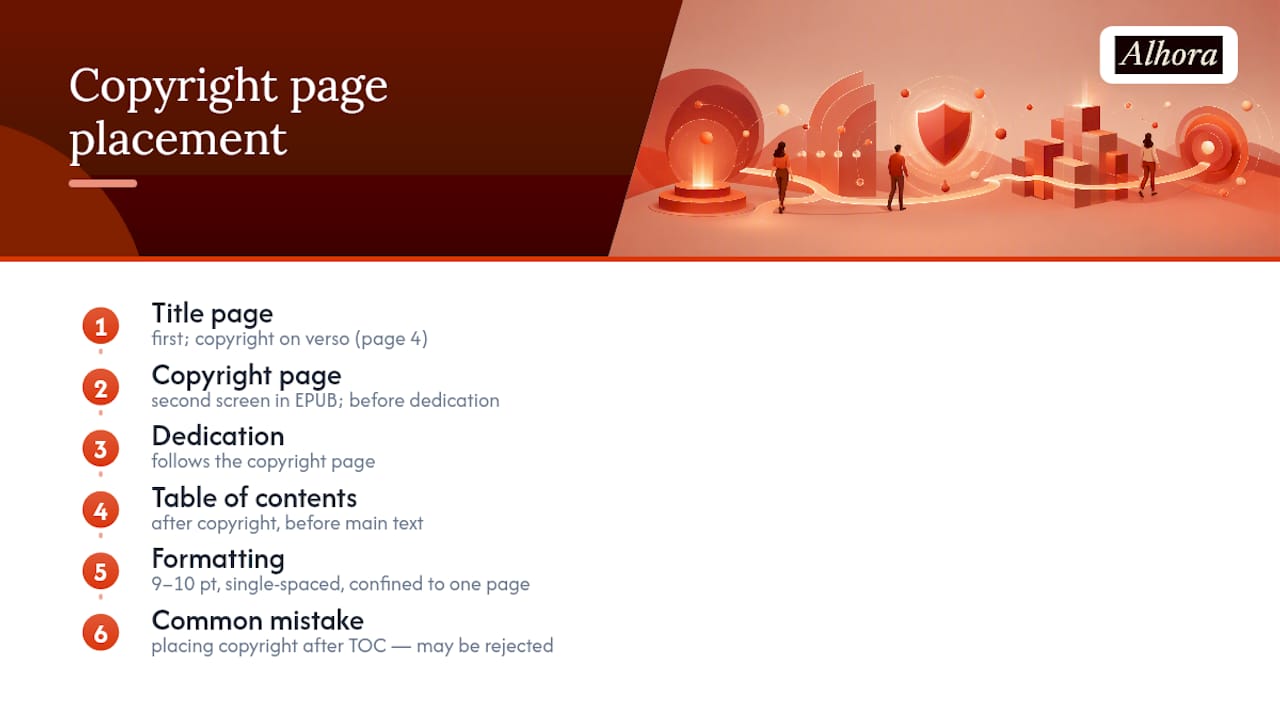
Print convention is strict here: the copyright page sits on the verso, the back side of the title page, which is page 4 in standard front-matter numbering. It comes before the dedication, before the table of contents, before anything else. That order is not a style preference. It reflects centuries of print convention, and retailers check for it.
Ebooks don't have a physical verso, but the logical order still matters. The copyright page should appear as the second screen a reader hits, right after the title page and before any dedication or foreword. Reflowable EPUB files don't preserve fixed page numbers, but they do preserve document order, and that's what platforms scan for.
On font size, print convention runs smaller than body text, typically 9 to 10 point, single-spaced, and confined to one page. There's no upside to a two-page copyright section. It reads as amateur and eats space a reader would rather spend on your actual book. Center or left-align the block; either works, though left-aligned tends to look cleaner with longer disclaimer text.
Pro Tip: If you're formatting the same manuscript for print and ebook, write one master copyright page first, then strip out anything print-specific (like the GPSR block, which only applies to physical copies distributed in the EU) for the ebook version. Keeping one canonical page and trimming it per format beats maintaining two separate drafts that drift out of sync.
The single most common mistake that trips up automated and manual retailer checks alike is sequencing. Authors place the copyright page after the dedication, after an epigraph, or worse, after the table of contents. KDP's automated scanner flags front-matter order as one of the first things it checks, and a misplaced copyright page is a quick way to get your file kicked back before a human ever looks at it.
Do You Need an ISBN, and How Do You Label It?
Print editions almost always need an ISBN; ebooks sometimes don't, depending on the retailer. Amazon assigns its own free identifier (an ASIN) to Kindle titles and doesn't require a separate ISBN for that store. Other ebook retailers, including Apple Books and Kobo through aggregators like Draft2Digital, typically want a valid ISBN before they'll list the title.
The rule that trips people up most is this: an ISBN is tied to a specific format and edition, not to "the book" as an abstract idea. ISBN International's own guidance is explicit that a new format, paperback versus hardcover versus ebook, needs its own unique number, even when the content inside is identical.
Practical labeling on the copyright page looks like this:
- Paperback ISBN: 978-0-000000-0-0
- Hardcover ISBN: 978-0-000000-1-0
- Ebook ISBN: 978-0-000000-2-0
- Audiobook ISBN (if applicable): 978-0-000000-3-0
If you use KDP's free ISBN for print, note that it's tied to Amazon and can't be transferred if you later move that edition to IngramSpark or another printer. Authors planning wide print distribution from the start usually buy their own ISBN block instead, since a portable ISBN travels with the book wherever it's sold.
One more line worth knowing about if you're pursuing library or academic distribution: the Library of Congress Control Number (LCCN), obtained through the Cataloging in Publication (CIP) program. It's not required for most self-published titles, but libraries and some institutional buyers look for it, and it's free to apply for if that market matters to you.
Copyright Notices, Rights Statements, and Disclaimers That Actually Hold Up
Copyright protection exists the moment you finish writing, not the moment you publish it. Still, a printed notice does real work: it tells a reader, a reviewer, or a retailer exactly who holds the rights and in what year the work went public, which matters if a dispute ever comes up later. Self-Publishing Advice frames it well: the notice "clarifies ownership and publication year," even though the underlying right was never in question.
For the rights statement itself, you've got two standard options.
Short version, fine for most fiction and nonfiction:
All rights reserved. No part of this publication may be reproduced, distributed, or transmitted in any form or by any means without the prior written permission of the publisher, except in the case of brief quotations embodied in critical reviews and certain other noncommercial uses permitted by copyright law.
That single paragraph covers the vast majority of self-published titles. You'd reach for the extended version mainly if you're granting specific permissions upfront, say, for educational excerpting or if a workbook includes reproducible pages meant to be copied. In that case, spell out exactly what's permitted rather than leaving it ambiguous.
Disclaimers vary a lot by genre, and mismatched disclaimer language is a quiet giveaway that an author copied a template without reading it. Fiction typically needs a version of: "This is a work of fiction. Names, characters, places, and incidents are either products of the author's imagination or used fictitiously." Memoir needs something closer to an acknowledgment that memory is imperfect and names may have been changed to protect privacy. Nonfiction, especially anything touching health, finance, or legal topics, needs stronger liability language stating the book is for informational purposes and isn't a substitute for professional advice.
If you've quoted lyrics, reprinted an image, or excerpted another author's work, the copyright page is also where that credit belongs, typically a short line like "Excerpt from [Title] by [Author], used with permission." Authors sometimes assert moral rights here too, a line like "The moral rights of the author have been asserted," which draws on protections set out in the UK's Copyright, Designs and Patents Act 1988. It's optional for most indie titles but common in UK-published work.
AI Disclosure and EU Product-Safety Rules You Can't Skip Anymore
Two newer requirements have started showing up on copyright pages that didn't exist a few years ago: AI-use disclosure and EU product-safety contact information. Neither is universally mandatory yet, but both are becoming standard practice fast enough that skipping them can cost you credibility or, in the EU case, compliance.
AI disclosure. If you used AI tools anywhere in the writing, editing, or image-generation process, a short disclosure line is increasingly expected. This kind of transparency signal is separate from platform-level disclosure, like the checkbox KDP asks authors to complete during upload. The checkbox satisfies Amazon's internal policy. A printed line on the copyright page satisfies the reader picking up your physical book, who has no way of seeing what you checked during upload. A minimal version reads: "This book was written by the author. AI tools were used for [grammar checking / research assistance], and all creative content is human-written."
EU product-safety (GPSR). Since December 13, 2024, physical products sold into the EU, including printed books, fall under the General Product Safety Regulation. Books don't come in packaging the way a toy or an appliance does, so that contact information typically lands on the copyright page or back cover instead.
The required GPSR block includes:
- Manufacturer or publisher's full name
- A postal address (not a PO box) where the publisher can be reached
- A contact email address
- An EU-based authorized representative, if the publisher is located outside the EU
If you're a UK-based or US-based author selling print copies through a distributor that reaches EU retailers, you have three practical paths: appoint an EU-based authorized representative, work through a fulfillment or distribution partner that already handles this for you, or list your own compliant contact details if you have a genuine EU address to use. Skipping this line entirely risks a title being pulled from EU-facing sales channels rather than just delayed.
Roughly this is the only new legal category that's appeared on the copyright page in years, and it applies narrowly. It affects physical books shipped into EU markets. It does not affect ebook-only titles or print runs sold exclusively in the US or UK.
Copy-Paste Copyright Page Templates for Common Scenarios
Below are five templates covering the situations most self-published authors run into. Replace anything in brackets; delete any line that doesn't apply to your book.
1. Minimal template (basic fiction or nonfiction, ebook or print, no EU distribution)
Copyright © [Year] by [Author Name]

All rights reserved. No part of this publication may be reproduced, distributed, or transmitted in any form or by any means without the prior written permission of the publisher, except in the case of brief quotations embodied in critical reviews and certain other noncommercial uses permitted by copyright law.

ISBN: [Paperback ISBN] (Paperback)
ISBN: [Ebook ISBN] (Ebook)

First Edition, [Year]

[Publisher/Imprint Name]
2. Fiction template with standard disclaimer
Copyright © [Year] by [Author Name]

All rights reserved.

This is a work of fiction. Names, characters, places, and incidents either are products of the author's imagination or are used fictitiously. Any resemblance to actual persons, living or dead, events, or locales is entirely coincidental.

ISBN: [Paperback ISBN] (Paperback)
ISBN: [Ebook ISBN] (Ebook)

Cover design by [Designer Name]
Edited by [Editor Name]

[Publisher/Imprint Name]
First Edition, [Year]
3. Nonfiction template with liability and permissions language
Copyright © [Year] by [Author Name]

All rights reserved. No part of this publication may be reproduced, distributed, or transmitted in any form or by any means, including photocopying, recording, or other electronic or mechanical methods, without the prior written permission of the publisher.

This book is for informational purposes only. It is not intended as a substitute for professional [medical/legal/financial] advice. Readers should consult a qualified professional before acting on any information contained herein.

Excerpt from [Source Title] by [Author], used with permission.

ISBN: [Paperback ISBN] (Paperback)
ISBN: [Ebook ISBN] (Ebook)

[Publisher/Imprint Name]
First Edition, [Year]
4. AI disclosure addition (add to any template above)
This book was written by the author. AI-assisted tools were used for [grammar checking / light research], and all creative writing, structure, and ideas are the author's own.
5. EU-sold print addition (add to any print template)
Manufactured by: [Publisher Name]
Address: [Full Postal Address]
Email: [Contact Email]
EU Authorized Representative: [Name and Address, if applicable]
Keep one canonical copyright page for your manuscript and layer in the EU block only in the print-ready PDF headed for EU distribution channels; there's no need to carry GPSR text into a US-only ebook file.
Why Files Get Held: Retailer Checks and a Pre-Upload Fix List
KDP and IngramSpark check different things, and knowing the split saves you a support ticket. KDP's review leans automated, scanning front-matter order and basic metadata consistency. IngramSpark leans more toward manual review, and its reviewers pay closer attention to ISBN formatting accuracy and whether the printed ISBN matches what's registered in the metadata submission.
The most common causes of a hold, and how to fix each one:
- ISBN mismatch: the ISBN printed on the copyright page doesn't match the one entered in the platform's metadata field. Fix by copying the number directly from your ISBN agency record, not retyping it.
- Ordering error: copyright page appears after the dedication, epigraph, or table of contents. Fix by moving it to page 4, directly behind the title page.
- Missing format labels: a single unlabeled ISBN when the book exists in multiple formats. Fix by labeling each one explicitly, "Paperback," "Ebook," and so on.
- Missing GPSR block on an EU-bound print title: fix by adding the manufacturer contact information before resubmitting.
- Font too small or page cluttered: not usually a hold reason on its own, but a common quality flag on manual review passes.
Before you upload anywhere, run through a short checklist: confirm metadata matches the copyright page exactly, confirm every ISBN is labeled by format, confirm front-matter order puts the copyright page right after the title page, and generate a proof PDF to check that nothing shifted during export.
If you've been through two rejected uploads for the same formatting issue, that's usually the signal to bring in a professional formatter or a tool built to catch these errors automatically, rather than guessing at fix number three.
How a Formatting Studio Actually Handles the Copyright Page
Most of the copyright-page mistakes covered above trace back to one root cause: the information gets typed in manually, late, under deadline pressure, and nobody double-checks it against the metadata submitted separately to the retailer.
A cleaner workflow collects every relevant fact before typesetting even starts: legal name or pen name, all ISBNs by format, edition number, publisher address, and GPSR contact details if the print run is EU-bound. That front-loaded step removes the guesswork that causes mismatches later.
From there, an automated check on front-matter order catches a misplaced copyright page before it ever reaches a retailer's queue, the same category of error that trips up KDP's automated scanner. Typesetting engines built for this also handle widow and orphan prevention on the copyright page itself, since a stray single line of legal text hanging alone at the top of a new page looks unfinished even when the content is correct.
For authors formatting a series, the same copyright block usually needs to repeat across every title with only the ISBN and edition line changing. Batch formatting with version control means updating that template once and propagating it, rather than manually retyping five nearly identical pages and hoping none of them drift.
— James
How Alhora Handles Your Copyright Page and Cross-Platform Export
Some book formatting tools treat the copyright page as part of the front matter and check its placement automatically, enforcing correct order and running validation for major retailers to catch ordering errors before submission.
This type of software can manage ISBN and metadata fields alongside the manuscript to keep numbers consistent across formats, and often include AI-assisted checks that flag inconsistencies and formatting issues without altering creative text. They typically apply typography standards such as justification, hyphenation, and widow and orphan prevention to front matter just as to chapters.
If you're formatting a manuscript for ebook export across multiple stores or preparing a print and paperback file for KDP, start there and let the export checks handle the placement details covered in this guide.
Where This Guide's Facts Come From
The legal framing for copyright ownership and the optional moral-rights line draws on the UK's Copyright, Designs and Patents Act 1988, Section 30 and Section 77. ISBN labeling guidance comes from ISBN International, the format-specific numbering authority referenced throughout the identifiers section.
For templates, checklists, and copy-paste examples, Kindlepreneur's copyright page guide offers additional worked examples worth comparing against the ones above. For AI disclosure phrasing and the GPSR compliance requirements covering physical books sold into the EU, Self-Publishing Advice's guide for indie authors covers the practical mechanics in more depth. If your book is also headed for UK library distribution, it's worth reading up on legal deposit obligations separately, since that process runs independent of anything on the copyright page itself.
Sources
- Copyright, Designs and Patents Act 1988 — Section 77
- ISBN International
- Book Copyright Page: Examples, Templates, and What to Include
- Creative Self-Publishing: Creating Your Copyright Page: A Guide for Indie Authors