

Send one finished, retail-quality copy of your book to the British Library within one month of publication. That single act satisfies your core statutory duty. Deposit copies for the other five libraries get triggered separately, coordinated through the Agency for the Legal Deposit Libraries (ALDL), so you don't need to post six parcels yourself.
Before you do anything else, work through this short list:
- Prepare a finished, sale-ready copy, not a proof or an early print-on-demand pull.
- Gather your metadata: title, imprint, publication date, and ISBN or ISSN if you have one.
- If your title is digital-only, plan for electronic deposit instead of a postal copy.
Your legal basis for all of this is the Legal Deposit Libraries Act 2003, which sets the one-month clock running from your publication date.
Key Takeaways
Meeting UK legal deposit obligations comes down to one finished-quality copy to the British Library within one month, with the other five libraries handled through ALDL requests.
| Point | Details |
|---|---|
| Core deadline | Send a finished-quality copy to the British Library within one month of publication. |
| Six libraries, one direct copy | Only the British Library gets an automatic copy; the other five request theirs via ALDL. |
| Quality standard | Deposit copies must match your best retail edition, not a proof or budget print-on-demand version. |
| No ISBN exemption | Public availability alone triggers the deposit duty, ISBN or not. |
| Postage is your cost | Publishers cover delivery costs; ALDL and the libraries do not reimburse postage. |
| Prepare files with Alhora | Alhora's validation checks help you catch pagination, cover, and formatting issues before you deposit a print or ebook file. |
This article is general information, not a substitute for advice from a qualified lawyer. Consult a qualified legal professional about your own circumstances before acting on anything here.
Table of Contents
- What Legal Deposit Covers and Who Must Deposit
- How Many Copies, Which Libraries, and How Fast
- Submitting Print Books: Addresses, Packaging, and Quality
- Submitting Electronic Books and Digital-Only Titles
- Who Pays for Postage, and What Happens to Your Copy
- Special Cases: Regions, New Editions, and Exemptions
- What Happens If You Don't Deposit
- Pre-Deposit Checklist for Print and Ebook Files
- Why Legal Deposit Matters Beyond the Legal Requirement
- Get Your Files Deposit-Ready Before You Post Them
- Sources
What Legal Deposit Covers and Who Must Deposit
Legal deposit applies the moment you "issue copies to the public," a phrase that covers free giveaways and review copies just as much as paid sales. It's a broader trigger than most authors expect.
The scope is wide. Print books, pamphlets, maps, musical scores, and journals all count, and so do ebooks, websites, and other non-print formats once they're prescribed under the regulations. The Legal Deposit Libraries Act 2003 covers print outright and gives ministers power to extend the duty to digital formats, which is exactly what happened in 2013.
Responsibility sits with whoever publishes the work in the UK, whether that's a traditional publisher, a self-publishing author, or a distributor acting on a publisher's behalf. One detail trips people up constantly: not having an ISBN does not remove the obligation. Deposit libraries confirm that public availability alone makes a title liable for deposit, ISBN or no ISBN.
How Many Copies, Which Libraries, and How Fast
Only one copy is mandatory as a matter of course, and it goes to the British Library. The other five deposit libraries can request a copy, and when they do, that request usually runs through ALDL rather than each library contacting you directly.
The full network of six designated libraries is:
- The British Library
- The National Library of Scotland
- The National Library of Wales
- The Bodleian Libraries, University of Oxford
- Cambridge University Library
- The Library of Trinity College Dublin
Timing is fixed by statute. Under Section 4 of the Legal Deposit Libraries Act 2003, the British Library copy must arrive within one month of publication, and copies requested by the other five libraries are due within one month of that written request.
A workable delivery timeline looks like this: finalize your copy roughly one month before your publication date, package and address it about two weeks out, then post it on or before the day of publication.
Pro Tip: Pull your deposit copy from the same print run you're selling to readers. Ordering it separately later almost always costs more in rush postage and invites quality mismatches.
Submitting Print Books: Addresses, Packaging, and Quality
Print deposit is mostly logistics, but the details matter. Follow this order:
- Confirm you're sending a finished, retail-quality copy, not an advance proof.
- Attach or include full imprint details and your ISBN if one exists.
- Package the book to survive postal handling without damaged corners or a bent spine.
- Address it to the British Library's Legal Deposit Office at Boston Spa and send it within your one-month window.
Before you seal the package, check that:
- The copy matches your finished retail edition, cover and interior alike.
- Pagination is correct and complete, with no missing signatures.
- The text has been proofread to the standard you'd sell to a customer.
This last point is where publishers most often stumble. The Act requires a deposit copy to be of the same quality as the best copies produced at the time of publication, so a cheaper print-on-demand variant or an uncorrected proof doesn't meet the bar even if it's technically the same book.
Pro Tip: Print one extra copy specifically for deposit, send it tracked, and keep the receipt. If a library ever queries receipt, you'll have proof of postage in seconds rather than digging through old invoices.

Submitting Electronic Books and Digital-Only Titles
Ebooks and other digital publications work differently, and in some ways more simply. A single electronic deposit can satisfy the requirement for all six libraries at once, so you're not repeating the process six times over.
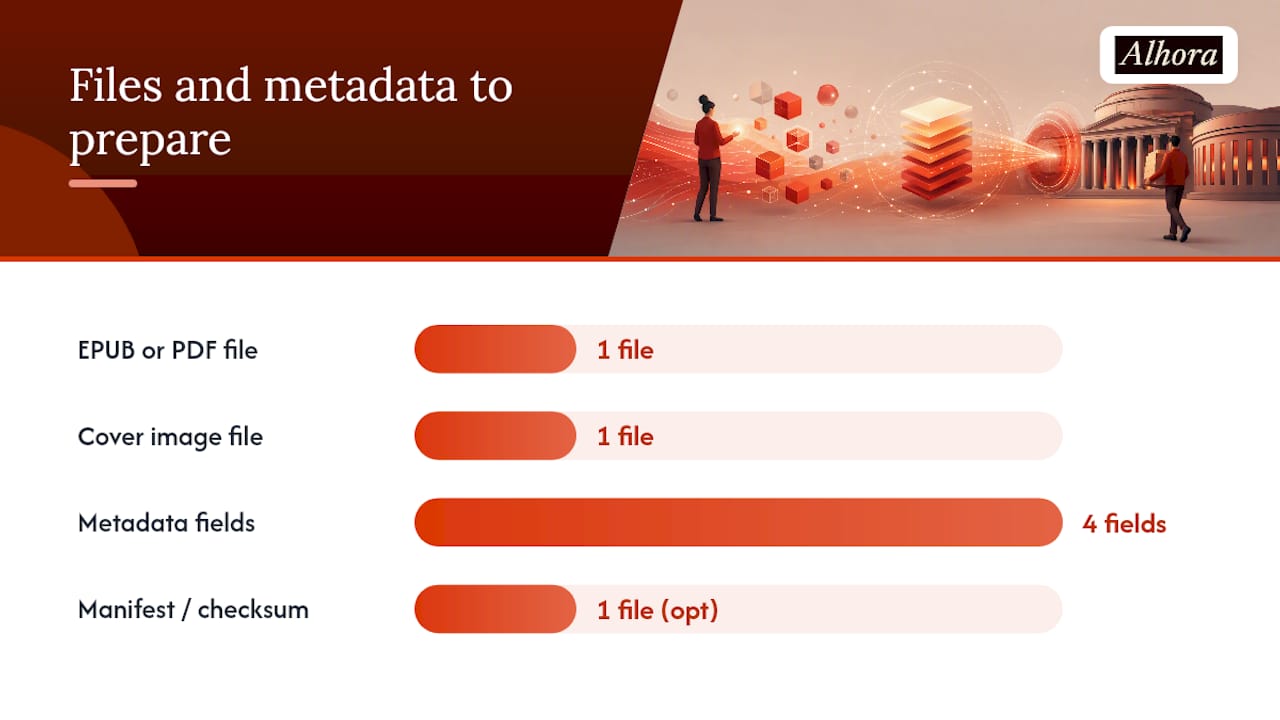
Before you submit, have these ready:
- A validated EPUB file, or an acceptable PDF where EPUB isn't appropriate.
- A clean cover image file separate from the interior.
- Basic metadata: title, author, publication date, and file naming that matches your records.
- A manifest or checksum file if your submission route supports one.
Your submission path depends partly on where you're based. Most publishers use the British Library's Publisher Portal, but publishers based in Scotland can route electronic deposits through the National Library of Scotland instead, and that single submission still reaches all five other libraries. Irish publishers connect through Trinity College Dublin and its edepositIreland service.
One operational note worth flagging: after the October 2023 cyber-attack disrupted British Library systems, some electronic deposit routes went down temporarily. If a portal isn't responding, contact the Digital Processing team directly for interim instructions rather than assuming your obligation has lapsed.
Pro Tip: Run your EPUB through a validator before you submit it. Files that fail validation get bounced back for correction, which quietly eats into your one-month window.
Who Pays for Postage, and What Happens to Your Copy
Postage and delivery costs sit with you, the publisher or author, not the library. ALDL is explicit on this: it cannot pay publishers for copies or postage, so budget for a first-class or tracked parcel as part of your production costs.
Once your copy arrives, here's what happens to it:
- It's catalogued and preserved for long-term access rather than active lending in most cases.
- Access policies vary slightly library to library, and electronic content may carry platform or onsite-only restrictions.
- Deposit does not transfer or affect your copyright. You still own the work in full.
Cataloguing timing isn't instant, so don't expect your title to appear searchable the same week it arrives.
Special Cases: Regions, New Editions, and Exemptions
A few situations need extra thought. Publishers in Scotland, Wales, or Northern Ireland can route electronic deposits through their national library, and Trinity College Dublin handles Irish deposits along with voluntary open-access submissions through edepositIreland.
New editions count as fresh publications if the changes are substantive, meaning a revised edition with real content changes needs its own deposit, not just a note referencing the original.
Self-published authors and small print runs get no free pass. The duty applies as soon as a work is made publicly available in the UK, regardless of print run size or whether you consider yourself a "real" publisher.
Websites and login-protected online content sit in a grayer zone. These may be captured for deposit if prescribed under the regulations, so contact the relevant national library directly if you're unsure whether your site or online publication qualifies.
What Happens If You Don't Deposit
The statutory duty exists whether or not you act on it, and libraries can and do request copies when they notice a gap. In routine cases the consequences are administrative rather than punitive, but the obligation itself doesn't disappear because you missed it.
The mistakes that cause the most trouble are predictable:
- Sending an uncorrected proof instead of the finished retail copy.
- Missing the one-month deadline entirely.
- Sending a lower-quality print-on-demand version when a better retail edition exists.
- Omitting basic metadata like ISBN, imprint, or publication date.
- Assuming no ISBN means no obligation. It doesn't.
Pre-Deposit Checklist for Print and Ebook Files
Run through this before you post or upload anything.
For print: a final retail-quality PDF or physical sample, correct pagination, a cover that matches your finished edition, a fully proofread interior, and complete production metadata including imprint and date.
For ebooks: a validated EPUB (or acceptable PDF), embedded fonts where your format calls for them, a separate cover image, a clear metadata file, and a checksum or manifest if your submission route accepts one.
Pro Tip: Keep a simple production log, publication dates, file versions, and delivery receipts, in one folder. It turns a future compliance question into a five-minute lookup instead of a scramble.
Why Legal Deposit Matters Beyond the Legal Requirement
Deposit isn't only paperwork. It gets your title recorded in the British National Bibliography, which is how researchers, students, and future readers find work that might otherwise vanish from view. Think of it as an insurance policy for your book's survival past your own website or backlist.
Deposit libraries frame it plainly: this system exists to preserve the nation's literary and scientific record, one title at a time, yours included.
Get Your Files Deposit-Ready Before You Post Them
A rejected deposit copy usually comes down to one thing: the file wasn't actually finished when it went out the door, mismatched pagination, an uncorrected proof mistaken for the final text, or a cover that doesn't match the interior. Alhora catches those problems before they leave your desk. Its typesetting engine handles justification, hyphenation, and widow and orphan control automatically, and its validation checks flag trim, bleed, and gutter issues across print and ebook formats before you print a single retail-quality copy.
For authors managing metadata across multiple platforms, having one clean export ready for the British Library and your retail channels saves a second round of corrections later. If you want a look at how publishers structure their own submission logistics, Maroon House Press's submissions guidance is a useful reference point. When you're ready to generate a finished, deposit-ready file, start with Alhora and export your next title with confidence.
Sources
- Legal deposit — Bodleian Libraries
- FAQs — Agency for Legal Deposit Libraries (ALDL)
- Legal Deposit Libraries Act 2003 — Section 4
- Legal Deposit — The British Library
- Access to electronic legal deposit restored — Cambridge University Libraries