
Formatting an ebook comes down to two practical paths: clean up your manuscript in Microsoft Word, apply semantic styles, and export to EPUB or upload directly to KDP, or use a dedicated formatting tool like Alhora to produce a validated EPUB, AZW3, or PDF with publisher-grade typography in one pass. Either way, one rule is non-negotiable: validate your exported EPUB with EPUBCheck and preview it in Kindle Previewer before uploading anywhere.
Which path fits you?
- Novice, prose-only novel: Word workflow. Apply Heading 1 to chapter titles, Normal style to body text, export DOCX to KDP or save as EPUB, then validate.
- Intermediate, wants polished output fast: Use a dedicated formatting tool. Alhora handles justification, hyphenation, widows/orphans, and accessible EPUB export automatically.
- Technical author or complex layout: Hand-code EPUB with HTML and CSS, or use Sigil for fine-grained control after an initial export.
- Illustrated book, children's book, or textbook: Hire a professional formatter or use a tool that supports fixed-layout EPUB and PDF exports with bleed/trim checks.
- Wide distribution (Apple Books, Kobo, B&N Press, Google Play): Produce EPUB, not PDF. EPUB is the open industry standard accepted by virtually every major retailer.
Pro Tip: Run EPUBCheck before you open Kindle Previewer. Previewer will sometimes display a broken file without flagging the structural error that will get your upload rejected.
Key Takeaways
Formatting an ebook correctly means applying semantic styles in your source file, validating the EPUB output before upload, and previewing on real devices before you publish.
| Point | Details |
|---|---|
| Semantic styles first | Apply Heading 1 to chapter titles and Normal to body text; this powers your TOC and navigation. |
| Remove print artifacts | Delete headers, footers, and page numbers from your source file before any export. |
| Validate with EPUBCheck | Run EPUBCheck on every EPUB export; zero errors is the target before uploading to any retailer. |
| EPUB for wide distribution | EPUB is the open industry standard for reflowable prose; use PDF only for fixed-layout or image-heavy books. |
| Alhora for automated exports | Alhora handles typesetting, accessible EPUB export, and validation checks in one platform. |
Table of Contents
- What does your manuscript need before you start formatting?
- How do you format an ebook step by step in Microsoft Word?
- Which tools give you the fastest route to a formatted ebook?
- When is hand-coding EPUB in HTML and CSS actually worth it?
- How do you handle images, links, footnotes, tables, and accessibility?
- How do you create a working table of contents for EPUB and KDP?
- What is the right process for exporting, validating, and testing your ebook?
- How do you fix the most common ebook formatting problems?
- Should you format your ebook yourself or hire a professional?
- The formatting mindset that actually gets books published
- Get publication-ready ebook exports without the manual work
- Sources
What does your manuscript need before you start formatting?
Formatting on top of a messy manuscript is like painting over rust: the problems resurface.
Remove all print-formatting artifacts:
- Delete headers, footers, and page numbers. KDP explicitly instructs authors to strip these because they cause rendering errors in reflowable ebooks.
- Turn off Track Changes and accept all revisions.
- Delete any manual tab stops, double spaces between sentences, and repeated blank lines used for visual spacing.
- Remove section breaks inserted for print pagination. You will replace these with proper EPUB page breaks.
Apply semantic styles throughout:
- Mark every chapter title with the Heading 1 style, not bold text at a large font size.
- Mark subheadings with Heading 2 or Heading 3 consistently.
- Set all body text to the Normal style. Never use a custom "My Body Text" style unless you map it explicitly during export.
- Avoid inline formatting for structure. Bold and italic for emphasis are fine; using them to fake a heading is not.
Insert real page breaks at chapter starts:
Use Insert > Break > Page Break (or the keyboard shortcut) at the end of each chapter, not a string of blank paragraphs. Do the same for front matter and back matter sections.
Front and back matter to prepare:
- Title page (title, subtitle if any, author name)
- Copyright page (year, rights statement, ISBN if you have one)
- Dedication (optional, keep it short)
- Table of contents placeholder (you will generate this from styles)
- Back matter: About the Author, series links using universal book links, and a reader CTA (review request, newsletter sign-up)
Metadata to gather before export:
- Full title and subtitle
- Author name exactly as it will appear on the cover
- Language code (e.g.,
enfor English) - ISBN (optional for ebooks, but required for some library distribution channels)
- Book description (your retailer blurb)
- BISAC subject categories (at least two)
Pro Tip: Save your clean manuscript as a separate file before you touch any formatting. Name it something like manuscript_clean_v1.docx. If a conversion goes wrong, you want a pristine source to return to.
How do you format an ebook step by step in Microsoft Word?
Word is where most indie authors live, and it produces acceptable EPUB exports when the styles are set correctly. The key is working with styles, not around them.
-
Start from a clean DOCX. Open your clean manuscript file. Go to Edit > Find & Replace, and use the regex
{3,}(or manually search for triple paragraph marks) to collapse excessive blank lines. Remove any remaining manual line breaks (Shift+Enter) that are not intentional. -
Configure the Normal style. Right-click Normal in the Styles panel, choose Modify, then Format > Paragraph. Set first-line indent to 0.2 inches, line spacing to single, and spacing before/after to 0pt. This is the style every body paragraph will use. KDP's formatting guide recommends exactly this approach: paragraph indents set through the style, not the ruler.
-
Apply Heading 1 to every chapter title. Click into the chapter title line, then click Heading 1 in the Styles panel. Do this for every chapter. This single step powers your automatic TOC and your EPUB navigation.
-
Generate an automatic Table of Contents. Place your cursor on the TOC placeholder page. Go to References > Table of Contents > Automatic Table 1. Word builds the TOC from your Heading 1 (and Heading 2/3) entries. This TOC will become the visible HTML TOC page in your EPUB.
-
Insert page breaks between chapters. Place your cursor at the end of the last paragraph of each chapter. Press Ctrl+Enter (Windows) or Cmd+Return (Mac) to insert a hard page break. Never use blank paragraphs to push content to a new page.
-
Insert images correctly. Place images inline (In Line with Text wrapping), not floating. Use JPG for photographs and PNG for illustrations or graphics with transparency. Keep image files under 2MB each. Add alt text via the image's Format Picture panel.
-
Export your file. You have two routes:
- Upload the DOCX directly to KDP. KDP converts it internally and Kindle Previewer lets you see the result before you commit.
- Export to EPUB (File > Save As > .epub in Word 365, or use a tool like Kindle Create), then run EPUBCheck and preview in Kindle Previewer before uploading.
The single most common Word-to-EPUB failure: authors apply bold + large font size to chapter titles instead of the Heading 1 style. The converter sees a bold paragraph, not a chapter, so the TOC is empty and navigation breaks entirely. One click on Heading 1 prevents it.
Pro Tip: Never use headers or footers in your Word document for ebook output. Even if they are blank, some converters carry them into the EPUB as stray text that appears on every screen.
Which tools give you the fastest route to a formatted ebook?
Not everyone wants to manage styles manually. Dedicated tools handle the structural work and let you focus on the book.
Tool categories and what they actually do:
- WYSIWYG formatting apps (such as Vellum on Mac, or Atticus): You import your manuscript, choose a design theme, and export clean EPUB and MOBI/KF8 files. Fast, polished, and platform-aware. The trade-off is limited typographic control and, in some cases, platform lock-in.
- Conversion and utility tools (Calibre, Sigil): Calibre converts between formats (DOCX to EPUB, EPUB to MOBI) and lets you edit metadata. Sigil is a full EPUB editor where you can open the raw HTML and CSS files inside your EPUB and fix them directly. Both are free.
- Online converters: Services that accept a DOCX or RTF and return an EPUB. Convenient for a quick pass, but they rarely handle complex styles, images, or metadata well. Always validate the output.
After any automated conversion, check these four things:
- TOC links resolve to the correct chapters (click every entry)
- Images scale correctly on a narrow screen (no overflow, no missing images)
- Metadata is complete (title, author, language, ISBN if applicable)
- Embedded fonts are either licensed for embedding or removed
Formatting tools that bundle export and validation reduce the iteration cycle significantly, but the validator is still your final authority. No tool output skips EPUBCheck.
| Tool type | Best for | Main limitation |
|---|---|---|
| WYSIWYG app | Fast, polished prose novels | Limited CSS control, Mac-only for some |
| Calibre | Format conversion, metadata editing | Minimal design control |
| Sigil | Fixing EPUB internals manually | Requires HTML/CSS knowledge |
| Online converter | Quick one-off conversions | Inconsistent metadata and image handling |
| Dedicated formatter (e.g., Alhora) | Validated, publisher-grade exports | Subscription required |

Pro Tip: Calibre is excellent for batch metadata editing and format conversion, but do not use its EPUB output as your final file without running EPUBCheck. Its converter is functional, not polished.
When is hand-coding EPUB in HTML and CSS actually worth it?
For most prose novels, it is not. But for enhanced ebooks, strict accessibility compliance, or when you are debugging conversion artifacts that no tool will fix cleanly, knowing the internals pays off.
When hand-coding makes sense:
- Your book has unusual typographic requirements (poetry with specific spacing, plays with character names styled differently)
- You need ARIA roles and epub:type attributes for accessibility or library distribution
- A converter keeps producing the same structural error and you need to fix it at the source
- You are building a fixed-layout EPUB with precise image placement
Minimal EPUB anatomy. An EPUB is a ZIP archive. The required files are: mimetype (uncompressed, first in the archive), META-INF/container.xml (points to the OPF), content.opf (the package document listing all files), nav.xhtml (the navigation document for EPUB 3), toc.ncx (for EPUB 2 compatibility), and your XHTML content files.
Starter workflow:
- Export chapter XHTML files from Word or Sigil as a starting point.
- Use semantic HTML throughout:
<h1>for chapter titles,<p>for body paragraphs,<ul>/<ol>for lists. - Write an external CSS file. Keep font sizes in
emor%, usetext-indentfor paragraph indentation, and avoidpxfor core text sizing. Ebook CSS is a suggestion to the reading system, not a final layout rule. - Add images with
<img src="images/chapter1.jpg" alt="Description of image" />. - Update the OPF manifest to list every file and update the spine to set reading order.
A properly structured chapter heading looks like this:
<section epub:type="chapter" role="doc-chapter">
  <h1>Chapter One: The Beginning</h1>
  <p>The first paragraph of the chapter, with no indent on the opening line.</p>
</section>
The
epub:typeattribute tells reading systems and screen readers what kind of content this section contains, which matters for accessibility and navigation.
Pro Tip: After any manual edit to an EPUB's internal files, re-run EPUBCheck immediately. A single misplaced tag or a missing manifest entry will cause a store rejection. Use Sigil for quick edits rather than a plain text editor, since Sigil updates the OPF automatically.
How do you handle images, links, footnotes, tables, and accessibility?
These are the details that separate a readable ebook from one that frustrates readers on half their devices.
Images:
- Use JPG for photographs, PNG for illustrations or anything with transparency.
- Set a CSS rule of
max-width: 100%on all images so they scale down on small screens without overflowing. - Every image needs alt text. Write a concise description of what the image shows, not "image" or the filename. Decorative images (dividers, ornaments) should use an empty alt attribute (
alt="") so screen readers skip them silently. - Verify every image path in the OPF manifest matches the actual filename exactly, including case. A mismatch causes a broken image on some devices even when it displays fine in others.
Hyperlinks and footnotes:
- Footnotes in ebooks should be bidirectional: a superscript number links down to the note, and the note links back up to the reference point. Most formatting tools handle this automatically; if you are hand-coding, use
<a href="#fn1" epub:type="noteref">and<aside epub:type="footnote" id="fn1">. - Avoid linking to external URLs in the middle of prose. Readers on e-ink devices cannot open a browser, and a dead link mid-chapter is jarring. Use universal book links (such as Books2Read) for back-matter marketing links so they work across all platforms.
Tables:
- Use HTML
<table>elements for data tables, never an image of a table. Images of tables are unreadable on small screens and inaccessible to screen readers. - Keep tables simple. Complex multi-column tables with merged cells often break on e-ink devices. If a table is genuinely complex, consider converting it to a list or a series of short paragraphs.
- Set
utf-8encoding in your EPUB's XML declaration and HTML meta tags. Test special characters (em dashes, curly quotes, accented letters) on at least two devices.
Accessibility checklist:
- Heading hierarchy is consistent (no jumping from H1 to H3, skipping H2).
- Every image has appropriate alt text or an empty alt attribute.
- The
xml:langattribute is set on the root element anddc:languageis set in the OPF metadata. - Link text is descriptive ("Chapter 3" not "click here").
- Run DAISY Ace for a deeper accessibility audit beyond what EPUBCheck covers.
Pro Tip: Decorative images with a non-empty alt attribute create noise for screen reader users. If the image adds no information, alt="" is the correct and accessible choice, not a lazy one.
How do you create a working table of contents for EPUB and KDP?
There are two distinct TOC structures in an EPUB, and authors frequently confuse them or produce only one.
-
The visible HTML TOC page is a regular XHTML page in your book's reading order. Readers see it when they flip to the front of the book. It contains linked chapter titles that jump to the correct location in the text.
-
The functional nav.xhtml (EPUB 3) and toc.ncx (EPUB 2) are navigation documents that the reading system uses to power the device's built-in chapter menu. They are not pages the reader reads; they are the index the device reads. Both are required for broad compatibility, since older Kindle devices and some NOOK readers still rely on the NCX.
Step-by-step TOC checklist:
- Confirm every chapter title uses Heading 1 (or the appropriate heading level) in your source file.
- Generate the visible TOC page from your formatting tool or Word's automatic TOC feature.
- Verify that the nav.xhtml
<nav epub:type="toc">element lists every chapter with a workinghrefpointing to the correct XHTML file and anchor ID. - Confirm the toc.ncx
<navMap>mirrors the same structure for EPUB 2 compatibility. - List both nav.xhtml and toc.ncx in the OPF manifest. Mark nav.xhtml with
properties="nav". - Run EPUBCheck. Any broken link in the nav will appear as an error.
- Open Kindle Previewer and click through every TOC entry to confirm it lands on the right chapter.
Pro Tip: Keep each front matter section (title page, copyright, dedication) as a separate XHTML file and include all of them in the OPF spine. Reading systems that open the book at the "start" position use the spine order, not the TOC, so a missing spine entry means readers land in the wrong place.
What is the right process for exporting, validating, and testing your ebook?
Export is not the finish line. It is the start of the validation pass. Uploading an unvalidated file to KDP or Apple Books is how authors end up with rejections, broken reader experiences, and one-star reviews about formatting.
Step-by-step export and validation routine:
- Choose your export format.
- EPUB for wide distribution (Apple Books, Kobo, B&N Press, Google Play, Draft2Digital). EPUB is the open industry standard for reflowable prose.
- DOCX or EPUB for KDP. KDP accepts both and converts internally to Kindle Format (KF8/AZW3).
- PDF only for fixed-layout or image-heavy books (photo books, design portfolios, some illustrated non-fiction). PDF does not reflow on small screens, making it a poor choice for prose.
-
Run EPUBCheck. Download the latest release from the W3C's GitHub repository or use an online validator. Zero errors is the target. Warnings are worth reviewing but will not always cause rejections.
-
Run DAISY Ace for accessibility. Ace produces an HTML report showing missing alt text, heading hierarchy issues, and missing metadata. Fix any critical errors before proceeding.
-
Preview in Kindle Previewer. Open your EPUB or DOCX in Kindle Previewer and check the Kindle tablet, phone, and e-ink device views. KDP recommends Kindle Previewer specifically to catch rendering issues before upload.
-
Preview in Apple Books or Kobo desktop. Drag your EPUB into Apple Books on a Mac or open it in the Kobo desktop app. These render EPUB differently from Kindle and will surface CSS issues that Previewer misses.
-
Test on a physical device if possible. Sideload the EPUB to a phone or e-reader. Small screens reveal image overflow, font size issues, and TOC problems that desktop previews hide.
What to spot-check in every preview:
- Chapter starts appear on a new screen (page break is working)
- TOC links land on the correct chapter
- Images display at the right size and are not cut off
- Drop caps (if used) render correctly and do not overlap text
- No orphaned headings (a chapter title stranded at the bottom of a screen with no following text)
- Special characters and footnotes display correctly
Pro Tip: Name your export files with version numbers: my-novel-v1.epub, my-novel-v2.epub. When a retailer flags an issue, you need to know exactly which file you uploaded and what changed between versions. A simple naming convention saves hours of confusion.
How do you fix the most common ebook formatting problems?
Most formatting errors have a clear cause and a direct fix. Work from the source file, not the exported EPUB, whenever possible.
Broken TOC links
Cause: chapter anchor IDs are missing or the nav.xhtml href values do not match the actual file and ID. Fix: regenerate the nav in your formatting tool, or open the EPUB in Sigil and manually verify that each <a href="chapter01.xhtml#ch1"> points to an element with id="ch1" in that file. Broken TOC links are one of the most common causes of retailer rejection.

Headers, footers, or page numbers appearing in the ebook Cause: print formatting was not removed from the source DOCX. Fix: open the source file, delete all headers and footers, remove page number fields, and re-export. Do not try to delete them from the EPUB directly; the source is the right place to fix this.
Images overflowing or appearing low-resolution
Inconsistent fonts or typography artifacts
Cause: embedded fonts are not licensed for embedding, or the reading system does not support the font and falls back unpredictably. Fix: either remove embedded fonts and rely on the reading system's default (which is reliable and readable), or use a font explicitly licensed for ebook embedding and declare it correctly in the CSS @font-face rule.
Widows, orphans, extra blank pages, and odd spacing
Cause: manual line breaks (Shift+Enter), hard returns used for visual spacing, or empty paragraphs used as spacers. Fix: search the source DOCX for manual line breaks and replace them with nothing (or a proper paragraph break). Remove all empty paragraphs used for spacing and replace with CSS margin-bottom on the relevant style.
Pro Tip: Always fix formatting problems in the source file, then re-export. Editing the EPUB directly is tempting but creates a divergence between your source and your published file. The next export will reintroduce the same error.
Should you format your ebook yourself or hire a professional?
The honest answer depends on four variables: book complexity, deadline, budget, and your tolerance for learning curve.
Decision checklist:
- Book type: Is it prose-only (novel, memoir, straightforward non-fiction)? DIY is entirely viable. Does it have complex layouts, heavy illustration, or data-heavy tables? Professional formatting or a specialized tool will save you significant time.
- Accessibility or library distribution: If you need EPUB Accessibility 1.1 compliance for library distribution (OverDrive, Bibliotheca), the requirements go beyond basic alt text. A tool or formatter that explicitly supports ARIA roles and epub:type attributes is worth the investment.
- Deadline: If you have two weeks to launch, learning a new tool from scratch is a risk. If you have two months, the learning curve pays off across your backlist.
- Technical comfort: Can you open a file in a text editor and read HTML without panic? Hand-coding or Sigil editing is accessible. If that sentence made you nervous, a WYSIWYG tool or a professional formatter is the right call.
- Budget: Professional formatting for a prose novel typically runs $100–$300. A formatting tool subscription costs a fraction of that per year and scales across every book you publish.
DIY works well for:
- Prose novels and short story collections
- Short non-fiction without complex tables or charts
- Backlist updates (price changes, new back matter, corrected typos)
Hire a professional for:
- Illustrated children's books and graphic novels
- Textbooks and academic works with complex tables, equations, or footnote-heavy layouts
- Fixed-layout EPUB projects where precise image placement is critical
- Any project requiring certified EPUB Accessibility compliance for institutional distribution
Where Alhora fits: Authors who want automated, validated exports with publisher-grade typography without hand-coding or hiring out. Alhora's typesetting engine handles justification, hyphenation, and widows/orphans automatically. Its AI-assisted proofreading flags issues without rewriting your text. And its accessible EPUB export is audit-gated, meaning the file passes structural checks before it leaves the platform. For authors publishing frequently across KDP, Apple Books, Kobo, and Draft2Digital, that combination of automation and validation reduces rework considerably.
Pro Tip: If you are on the fence, format one chapter yourself and run it through EPUBCheck and Kindle Previewer. The errors you see will tell you immediately whether you need more help or whether the DIY path is within reach.
The formatting mindset that actually gets books published
Most formatting guides treat the process as a technical checklist, and technically they are right. But the authors who get stuck are not the ones who skipped a step. They are the ones who tried to fix problems in the wrong place.

The single most useful shift in thinking: your source file is the truth. The EPUB is a snapshot of that truth at a moment in time. When something breaks in the EPUB, the instinct is to open the EPUB and patch it. That works once. The next export overwrites the patch, and you are back where you started. Fix the source, re-export, and validate again. That loop, done consistently, is what separates authors who publish cleanly from authors who spend weeks in circles.
Platform requirements change. KDP's guidance has evolved, Apple Books has tightened its accessibility requirements, and EPUB 3 is now the expected standard for new submissions on most major retailers. The tools that bundle export with validation, like Alhora, absorb those changes so you do not have to track every update manually. That is not a reason to skip understanding the basics. Knowing why EPUBCheck flags a missing nav entry means you can fix it in five minutes instead of five hours.
Get publication-ready ebook exports without the manual work
Formatting a manuscript correctly takes time, and the validation loop (export, check, fix, repeat) is where most authors lose hours they could spend writing.
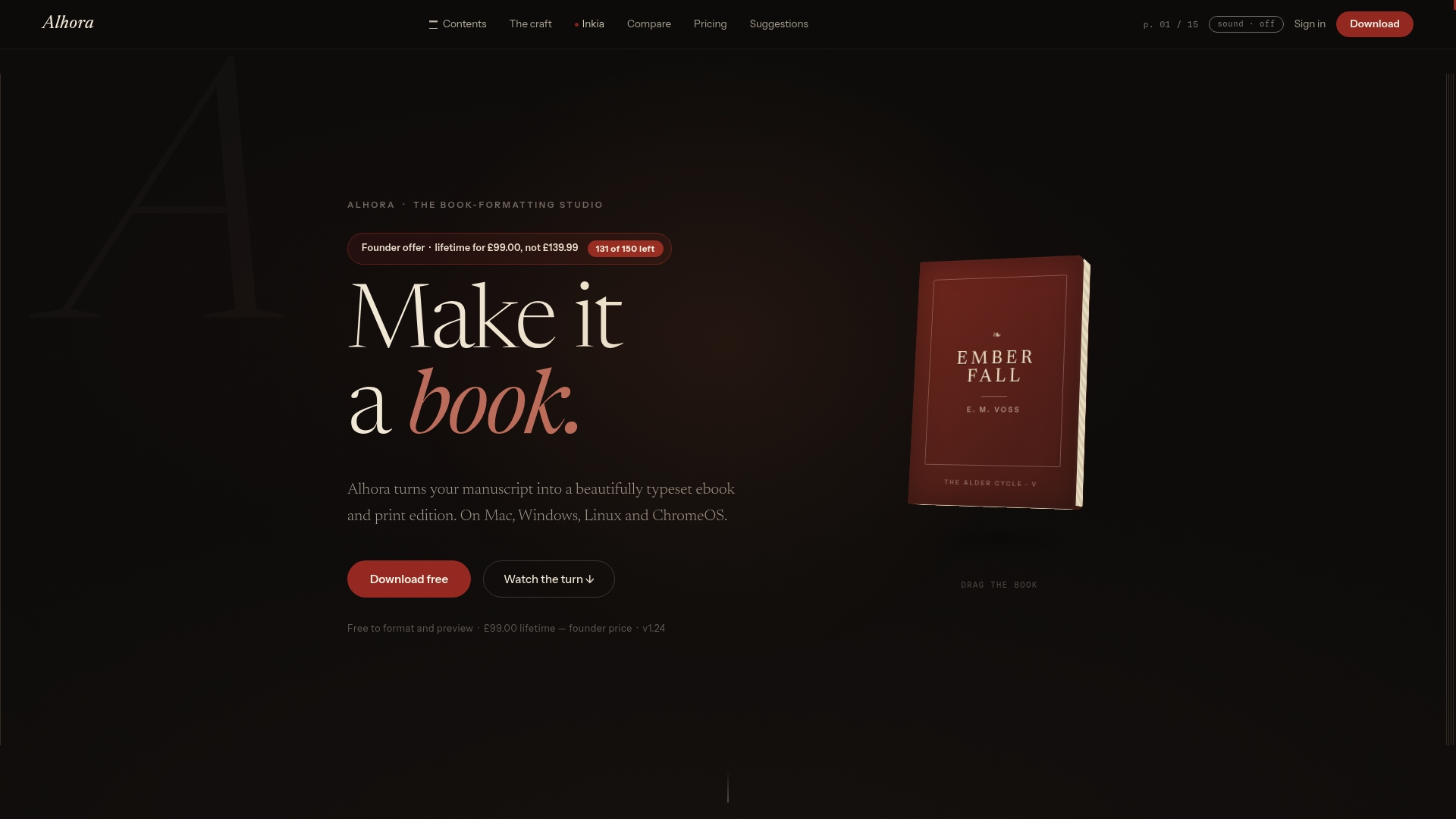
Alhora produces validated, publication-ready EPUB, AZW3, and print-ready PDF exports from your manuscript in one pass. Its typesetting engine automatically handles justification, hyphenation, and widows/orphans. The AI-assisted proofreading engine flags structural and editorial issues without touching your prose. Accessible EPUB export is audit-gated, so the file that leaves the platform is structurally sound before it reaches any retailer.
Alhora runs on Mac, Windows, Linux, and ChromeOS, and supports direct export to KDP, Apple Books, Kobo, IngramSpark, Draft2Digital, and Google Play. Monthly, annual, and lifetime license options are available, with publisher plans for teams.
Start formatting with Alhora and skip the validation loop entirely.
Sources
These are the primary resources to consult before uploading to any platform. Each one covers a specific part of the formatting and validation process.
- eBook Manuscript Formatting Guide
- Ebook Formatting: The Complete Guide | Rahatt Blog
- Ebook Formatting Guide: Design, Layout and Exporting Tips | Oxford Book Writing